When international auto parts buyers search for suspension components—especially ball joints—one of the most common questions they ask is: How many ball joints does a car have?
The answer is not as simple as “two” or “four.” Modern vehicles vary widely in suspension design, and the exact number of ball joints depends on the front suspension type, rear suspension structure, and vehicle class. For B2B buyers sourcing ball joints in bulk, understanding this is essential to making accurate purchase decisions, quoting clients, and avoiding costly mismatches.
This blog breaks down the full explanation in a professional, technical, and B2B-oriented way—helping you as a wholesaler or distributor make smarter procurement choices.
What Is a Ball Joint and Why Does It Matter?
A ball joint is a pivoting spherical joint that connects the vehicle’s control arm to the steering knuckle.
Its functions include:
- Allowing vertical suspension movement (up and down)
- Allowing steering movement (left and right)
- Maintaining wheel alignment
- Ensuring chassis stability and safe handling
In a commercial sense, ball joints are among the highest-demand suspension items for wholesalers dealing with steering and suspension systems. Why?
Because ball joints wear out regularly due to:
Road vibration
Dirt and sand intrusion
Heavy loads
Poor lubrication
High-mileage driving
This leads to strong recurring demand—especially in markets like South America, Middle East, Africa, Europe, and Southeast Asia, where road conditions vary significantly.
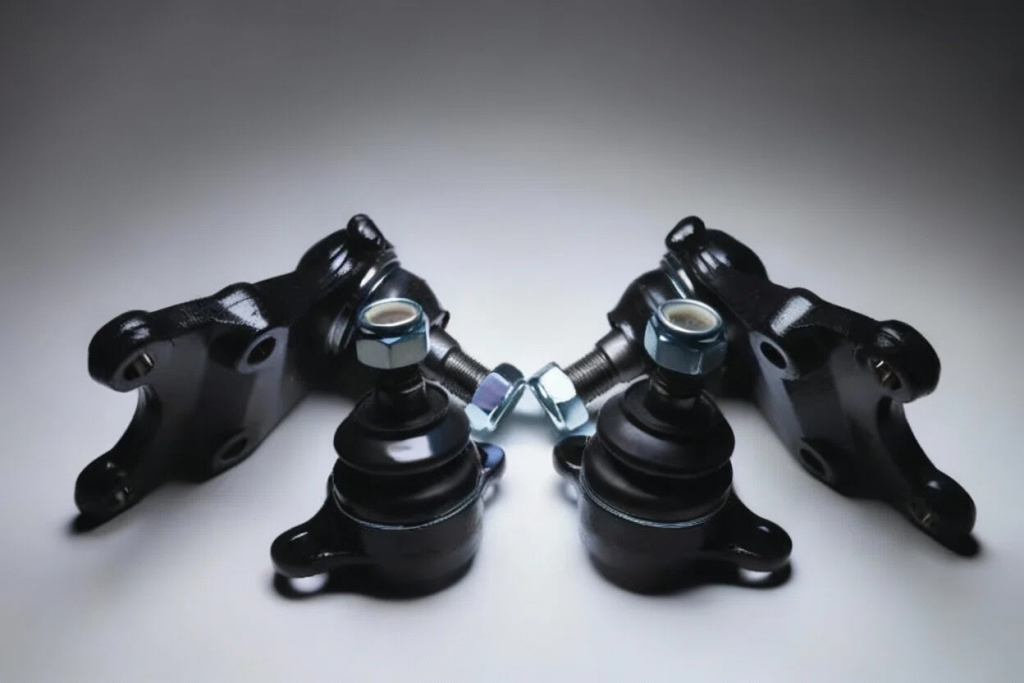
So How Many Ball Joints Does a Car Have?
The exact number depends on suspension design. In general:
Most cars have 2 to 4 ball joints.
But here is a more accurate breakdown:
| Suspension Type | Upper Ball Joint | Lower Ball Joint | Total |
| MacPherson Strut (most common) | No | Yes | 2 ball joints |
| Double Wishbone (pickup trucks, SUVs) | Yes | Yes | 4 ball joints |
| Heavy-duty 4×4 / Off-road Trucks | Often Yes | Yes | 4 or more ball joints |
Let’s break these down.
How Suspension Type Affects the Number of Ball Joints
MacPherson Strut Suspension (Most Common Cars)
Used in:
Toyota Corolla, Honda Civic, Nissan Sentra, Hyundai Elantra, Ford Focus…
MacPherson strut suspension uses one lower ball joint per wheel.
This means the front axle has:
2 lower ball joints
No upper ball joints (the strut top mount replaces that function)
Total: 2 ball joints
This is the most common configuration in global passenger cars.
Double Wishbone Suspension (Pickups, SUVs, Vans)
Used in:
Toyota Hilux, Mitsubishi L200, Ford Ranger, Toyota Land Cruiser, Honda Accord (some models)
Double wishbone suspension has:
- 1 upper ball joint per wheel
- 1 lower ball joint per wheel
Total: 4 ball joints
These ball joints typically handle heavier loads, making them a high-demand product for aftermarket wholesalers.
Multi-link and Heavy-duty Suspension Systems
Some premium vehicles and heavy-duty SUVs use a multi-link structure that may incorporate:
Additional lower arms
Additional upper arms
Extra ball joints for geometry control
Total: 4 to 6 ball joints
depending on the model.
Examples include:
- Mercedes-Benz SUV models
- Toyota Land Cruiser 200/300
- Ram 1500 front suspension
- Nissan Patrol Y62
These systems require high-precision and durable ball joints, creating opportunities for premium replacement markets.
Do Rear Wheels Have Ball Joints?
In most passenger cars:
Rear wheels DO NOT have ball joints.
Why?
Because most rear suspensions are:
Torsion beam
Multi-link with bushings
Solid axle (trucks)
These use bushings instead of ball joints.
However, some advanced multi-link rear suspensions DO use rear ball joints, usually:
1 per side
Or 2 per side in high-end vehicles
These are less common but represent a growing category for exporters and wholesalers.
Why Understanding Ball Joint Quantity Matters for B2B Buyers
Inventory Planning
If you know which suspension system a customer’s vehicle fleet uses, you can:
Stock accurate quantities
Reduce slow-moving items
Increase fast-moving SKU availability
For example:
MacPherson: 2 ball joints per car
Double Wishbone: 4 ball joints per car
Correct Quotation for Clients
Customers may call and say:
“I need ball joints for my Toyota Hilux.”
You must know that a Hilux typically uses 4 ball joints, not 2.
Avoiding Fitment Errors
Supplying the wrong ball joint type or count results in:
- High return rate
- Loss of brand trust
- Increased logistics cost
- Knowledge = fewer mistakes.
Market Positioning
Pickups and SUVs with double wishbone suspension often use higher-margin ball joints, ideal for distributors targeting:
- South America
- Middle East
- Africa
- Australia
- Southeast Asia
These regions have large commercial-vehicle user bases.
Symptoms of Worn Ball Joints (What Your Buyers Always Ask)
As a professional ball joints supplier or manufacturer, you must understand the failure indicators customers report.
Common symptoms include:
- Clunking noise when turning
- Uneven tire wear
- Vibration in steering wheel
- Loose steering feeling
- Car pulling to one side
- Front wheels out of alignment
- Metal-to-metal scraping
Wholesalers and garage chains order ball joints frequently because they are wear-and-tear components, especially in rough-road markets.
How Long Do Ball Joints Last?
On average:
Passenger car ball joints: 70,000 – 150,000 km
Pickup / SUV heavy-duty ball joints: 50,000 – 120,000 km
Commercial vehicles in poor road conditions: 30,000 – 60,000 km
This lifespan varies depending on:
- Driving load
- Road conditions
- Ball joint material quality
- Rubber dust boot durability
- Grease sealing performance
This is why high-quality aftermarket ball joints have strong repeat demand globally.
Types of Ball Joints Auto Parts Buyers Should Know
Lower Ball Joints
- Handle the most weight
- Typically larger and stronger
- Highest replacement frequency
Upper Ball Joints
- Found in double-wishbone vehicles
- Assist in wheel alignment and geometry control
Adjustable Ball Joints
- Used for performance tuning or lifted trucks.
Sealed vs. Greaseable Ball Joints
| Type | Advantage | Suitable Market |
| Sealed Ball Joints | Maintenance-free | Passenger cars, fleet vehicles |
| Greaseable Ball Joints | Longer lifespan with maintenance | Pickup trucks, 4×4, commercial vehicles |
How to Choose a Reliable Ball Joints Supplier or Manufacturer
When sourcing ball joints, quality and consistency matter more than low price. Here’s what to check:
OEM-grade steel material
- Forged steel improves load capacity and lifespan.
Dust boots made with high-performance rubber
- Prevents grease leakage and dirt intrusion.
CNC machining accuracy
- Ensures proper fitment and zero vibration.
Heat treatment process
- Improves wear resistance under heavy load.
Salt-spray corrosion performance
- Especially important for coastal or humid markets.
Certification
- ISO/TS16949, IATF16949, or equivalent.
Packaging options for B2B
- Neutral box, customer logo printing, anti-rust packaging.
Stable output capacity
- Ensures wholesalers receive stock steadily.
As a professional ball joints manufacturer and exporter, UJOIN Auto Parts offers high-performance control arm ball joints, suspension ball joints, and steering ball joints engineered for global markets.
Why Partner With UJOIN Auto Parts as Your Ball Joints Supplier?
UJOIN Auto Parts specializes in supplying high-quality suspension and steering components to importers, wholesalers, and distributor networks worldwide.
Our Strengths
- Over 2,000+ ball joint SKUs
- OEM-level forging and machining
- High-strength rubber boots
- Strict quality control for every batch
- Support for bulk orders and customization
- Fast delivery for South America, Middle East & Africa
- Flexible brand packaging (OEM, ODM supported)
Target Vehicles We Supply:
- Toyota: Corolla, Hilux, Hiace, Land Cruiser, Honda, Hyundai, Kia, Chevrolet, VW and more
- Nissan: Navara, Patrol, Tiida
- Ford: Ranger, F-150
- Mitsubishi: L200, Pajero
Whether you are a ball joints distributor, importer, or chain workshop, UJOIN Auto Parts provides stable production and consistent quality.
Final Answer: How Many Ball Joints Does a Car Have?
To summarize:
Most cars: 2 ball joints
Pickup trucks/SUVs: 4 ball joints
Heavy-duty or multi-link systems: 4–6 ball joints
Rear ball joints: Rare, only in some multi-link suspensions
Knowing the suspension type is the key to ordering the correct quantity and models.
Conclusion
Understanding how many ball joints a car has is essential for correct procurement, inventory optimization, and professional client service. As global demand for replacement suspension parts continues to grow, choosing a reliable ball joints supplier or ball joints manufacturer is critical for long-term business success.
If you need high-quality ball joints for your market, UJOIN Auto Parts is ready to support your wholesale business with professional manufacturing, competitive pricing, and stable supply.