Step by step of The Process for Placing an Order from an Online Auto Parts Supplier
In today’s global auto parts industry, the shift toward online procurement has transformed how distributors, wholesalers, and workshop chains source inventory. Instead of relying solely on traditional trade shows, offline sourcing agents, or local importers, more B2B buyers now prefer working directly with an online auto parts supplier. The reason is clear: online suppliers provide transparency, speed, product diversity, and access to high-quality manufacturers at competitive prices.
However, for B2B buyers, placing an order online is not the same as buying retail auto parts on a consumer marketplace. The process requires structured communication, confirmation of technical specifications, careful verification, and a clear understanding of logistics arrangements.
To help buyers streamline procurement, this article provides a comprehensive step-by-step guide to the entire process of placing an order with an online auto parts supplier—from initial communication to final shipment. Whether you are sourcing brake pads, control arms, water pumps, steering racks, or other automotive components, this workflow ensures smooth, efficient, and cost-effective ordering.
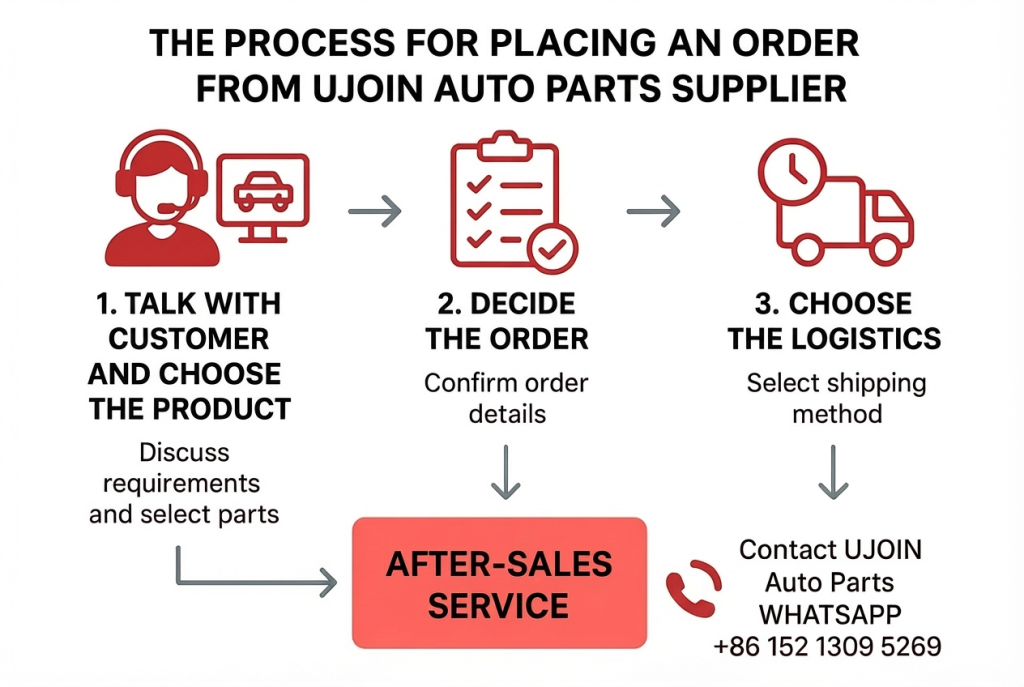
1. Initial Contact: Discussing Requirements and Selecting the Right Products
The first and most important step of ordering from an online auto parts supplier is establishing a clear communication channel. This stage sets the foundation for the entire transaction. For B2B buyers, accuracy matters—wrong parts mean customer complaints, returns, stock delays, and unnecessary losses. Therefore, communication must be detailed and professional.
1.1 Providing Clear Vehicle and Part Information
To help the supplier identify the correct product, buyers should provide as much information as possible, including:
- OEM number (Original Equipment Manufacturer part number)
- Vehicle make, model, and engine details
- Year range
- Required quantity
- Specific technical requirements (material, coating, brand preference, etc.)
Whether private labeling or custom packaging is needed
Example:
- OEM: 6C1Q-6C315-AA
- Vehicle: Ford Transit 2.4 TDCi
- Part: Water Pump
- Quantity: 200 pieces
- Packaging: Neutral box + label
The more detailed the information, the faster the supplier can match the correct item.
1.2 Reviewing the Supplier’s Product Catalog
Reliable online auto parts suppliers typically offer:
- Product catalogs in PDF or Excel
- Online listings with specifications
- Factory certificates
- Detailed product photos and videos
- Quality inspection reports
Buyers should review these documents to verify product compatibility. For bulk procurement, many customers prefer to request:
- Additional product photos
- Videos of stock or warehouse
- Comparisons with original parts
- Material or coating explanations
This stage helps eliminate misunderstandings and ensures both sides are aligned on what will be delivered.
1.3 Technical Consultation with the Supplier
Auto parts can be complex. For example:
- Brake pads may differ in friction formulas.
- Control arms may vary by ball joint type.
- Water pumps may include plastic or metal impellers.
- Steering racks differ between hydraulic, electric, and manual systems.
- A good supplier will help the buyer choose the best option based on:
- Market demand
- Climate and road conditions
- Customer preferences
- Vehicle version differences
This consultation improves accuracy and reduces product return risks.
1.4 Requesting Samples (Optional but Recommended)
Depending on the order size, buyers may request samples before committing to a full purchase. A sample test helps evaluate:
- Product quality
- Packaging
- Fitment accuracy
- Material durability
- Workmanship consistency
For large B2B orders, sample confirmation is an important part of quality control.
2. Confirming the Order: From Quotation to Contract
Once the buyer and supplier agree on the exact products needed, the next stage is order confirmation. This process involves pricing, documentation, terms, and production planning.
2.1 Receiving and Reviewing the Quotation
A standard quotation from an online auto parts supplier should include:
- Product description
- OEM reference numbers
- Unit price
- Minimum order quantity (MOQ)
- Total quantity
- Trade terms (FOB, CIF, EXW, DAP, etc.)
- Production or delivery time
- Packaging method
- Payment terms
Buyers should carefully evaluate the quotation based on:
- Price competitiveness
- Quality guarantees
- Brand consistency
- Delivery timeline
- After-sales support
This ensures the quotation aligns with business and market needs.
2.2 Negotiating Order Details
Most B2B transactions require negotiation. Typical discussion points include:
- Price adjustments for higher quantities
- Combining multiple products into one shipment
- Free labels or branding support
- Production speed for urgent orders
- Deposit percentages
- Packaging upgrades
Experienced suppliers show flexibility and provide long-term cooperation benefits.
2.3 Proforma Invoice (PI) and Contract Issuance
Once everything is agreed upon, the supplier issues a Proforma Invoice, which serves as the official confirmation document. It includes:
- Full product list
- Unit and total pricing
- Shipping terms
- Payment terms
- Bank details
- Delivery schedule
The buyer reviews the PI and confirms it formally.
2.4 Down Payment and Order Activation
Most suppliers activate production after receiving a deposit, usually:
- 30% down payment for production orders
- 100% payment for in-stock orders
Once payment is confirmed, the supplier begins manufacturing, quality checks, or order preparation.
2.5 Order Production and Quality Control
For manufacturers and direct factories, production includes:
- Raw material sourcing
- Machining and assembly
- Coating or plating
- Balancing, hardness, or pressure testing
- Final inspection
- Packaging
- Buyers may request:
- Production photos
- Videos of the line
- Inspection reports
- Packaging confirmation
A transparent supplier ensures buyers remain updated throughout the entire process.
3. Choosing Logistics: Shipping Methods, Costs & Documentation
Logistics is a major component of international B2B trade. Selecting the right shipping method can significantly affect cost, delivery speed, and customer satisfaction. Online auto parts suppliers must guide buyers through logistics choices to ensure smooth delivery.
3.1 Common Shipping Options for Auto Parts
Depending on the urgency, budget, and order size, buyers typically choose from three logistics solutions:
Sea Freight (Most Common for Bulk Orders)
Best for:
- Large wholesale orders
- Heavy items like control arms, brake rotors, steering racks
- Export to South America, Europe, Africa, Middle East
Benefits:
- Low cost per cubic meter
- Suitable for large shipments
- Highly reliable for B2B trade
Sea freight can be arranged as:
- FCL (Full Container Load): 20ft or 40ft container
- LCL (Less than Container Load): shared cargo
Air Freight (Fast Delivery)
Best for:
- Urgent orders
- Lightweight items
- Initial samples or trial orders
- Benefits:
- Fast
- Safe
- Reliable
- Cost is higher than sea freight.
Express Courier (Small Quantities)
Best for:
- Samples
- Small spare parts
- Replacement shipments
- Common options: DHL, FedEx, UPS, TNT.
3.2 Choosing the Right Incoterm
B2B buyers usually select from:
- FOB (Free On Board): Supplier delivers to China port; buyer arranges sea freight.
- CIF (Cost, Insurance & Freight): Supplier handles shipping to destination port.
- EXW (Ex-Works): Buyer arranges everything from supplier’s warehouse.
- DDP (Delivered Duty Paid): Supplier handles door-to-door delivery including duty.
For new buyers who want convenience, DDP is becoming increasingly popular.
3.3 Shipping Preparation and Documentation
Once the order is ready, the supplier prepares all export documents:
- Packing list
- Commercial invoice
- HS codes
- Bill of lading (B/L)
- Certificate of origin (CO, FORM E, FORM F, etc.)
- Quality certificates
Accurate documentation prevents customs delays and additional fees.
3.4 Tracking Shipment and Final Delivery
After loading:
- The supplier sends loading photos or videos
- Buyer receives the shipping details
- Tracking is provided through the forwarder
- Supplier monitors shipment until arrival
Good online suppliers continue supporting the buyer during customs clearance and final delivery.
4. After-Sales Service: Ensuring Long-Term Reliability and Support
Working with a professional online auto parts supplier is not only about receiving the products—it is about maintaining long-term performance, stability, and confidence in every shipment. At UJOIN Auto Parts, after-sales service is integrated into our complete supply chain process to ensure B2B buyers experience smooth operations even after the order is delivered.
4.1 Quality Guarantee for All Products
All products supplied by UJOIN Auto Parts—whether brake pads, water pumps, control arms, or steering racks—come with a quality assurance policy that includes:
- Strict factory inspection
- Professional technical evaluation
- Fitment verification before shipment
- Warranty support based on product category
- Rapid response for any quality-related concerns
We understand that B2B distributors rely on stable quality to support their own customers. This is why every batch is checked, documented, and packed according to export standards.
4.2 Fast Response for Claims and Technical Issues
If buyers encounter any issues such as:
- Product fitment mismatch
- Packaging damage during transportation
- Quantity discrepancies
- Market performance concerns
- Technical questions during installation
Our team provides immediate support. We evaluate the issue, analyze the root cause, and propose fast solutions such as replacement, compensation, or technical guidance depending on the case.
4.3 Continuous Replenishment and Market Support
For long-term partners, we also offer:
- Regular stock updates
- Fast replenishment for high-turnover items
- New model development support
- Customized packaging and branding
- Exclusive distributor quotations
This ensures our buyers can maintain strong market competitiveness.
4.4 Dedicated One-on-One Account Service
Each B2B customer is supported by an account consultant who handles:
- Product selection
- Quotation updates
- RFQ processing
- Production follow-ups
- Logistics coordination
- After-sales reporting
This one-on-one service ensures communication is efficient and problem-solving is fast.
5. Conclusion
A Smooth Ordering Process Ensures Long-term Business Success
The order process with an online auto parts supplier is more than a simple transaction. It requires structured communication, technical verification, and coordinated logistics. By following the three core stages outlined above—discussing requirements and selecting products, confirming the order, and choosing logistics—B2B buyers can achieve:
- Reduced procurement risks
- Faster sourcing cycles
- Lower operational costs
- Enhanced inventory reliability
- Stronger supplier relationships
For wholesalers, importers, and distributors, working with a professional online auto parts supplier not only improves efficiency but also provides a competitive edge in a rapidly evolving industry.