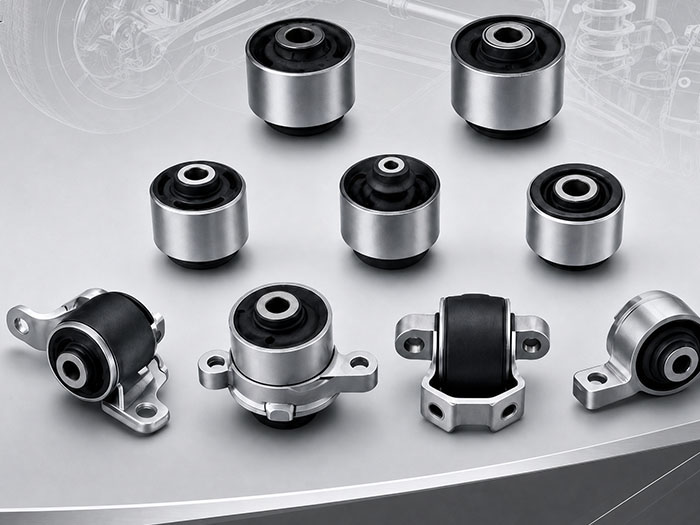
For global auto parts distributors, importers, and wholesalers, the control arm bushing is far more than a simple rubber-to-metal component—it is a high-volume, strategic inventory anchor within the suspension product line. Because it directly impacts vehicle handling, steering precision, noise, vibration, and harshness (NVH), as well as overall driving safety, the demand for high-quality aftermarket replacements is expanding exponentially across global markets.
However, navigating the global supply chain to source these precision-engineered components presents significant challenges. For wholesale buyers, ensuring long-term profitability requires moving beyond surface-level pricing. It demands a granular understanding of material science, OE compatibility, rigorous quality testing, and the manufacturing capabilities of China auto spare parts suppliers. This comprehensive buying guide provides procurement managers with the technical data and strategic insights needed to optimize their supply chain and establish a robust market advantage.
How to Maximize Profit Margins From China Control Arm Bushings Supplier
Toggle
WHAT IS A CONTROL ARM BUSHING?
A control arm bushing is a crucial, high-elasticity mechanical joint positioned between the vehicle’s control arm (wishbone) and the structural chassis. Operating as a structural pivot point, its primary function is to absorb road shocks, dampen high-frequency vibrations, and allow the suspension links to articulate smoothly during cornering, acceleration, and braking.
In the global automotive aftermarket, these components are highly sought after both as individual SKUs for targeted repairs and as core components within complete suspension repair kits (bundled alongside ball joints, control arms, and tie rod ends) to capture higher average order values (AOV).
WHY CONTROL ARM BUSHINGS ARE HIGH-PROFIT ANCHORS FOR WHOLESALE BUYERS
Adding a deep inventory of control arm bushings to your wholesale catalog offers clear commercial advantages:
- High-Frequency Replacement Cycle: Suspension systems constantly endure dynamic loads, environmental debris, and extreme temperature fluctuations. This makes bushings high-wear items that vehicle owners and fleet operators must replace regularly.
- Broad Fleet Interoperability: Unlike highly specialized engine parts, basic bushing geometries cross-reference across vast vehicle platforms. A single multi-application SKU can service multiple model years across Asian, European, and American vehicle makes, significantly lowering inventory holding costs (carrying costs).
- Predictable, Recurring Revenue: Professional repair garages and regional jobbers maintain a steady, non-seasonal demand for these parts, ensuring highly predictable reorder cycles for wholesale distributors.
- High Basket Attachment Rates: Bushings are rarely ordered in isolation. They act as “gateway parts” that pull in secondary sales of high-margin items like steering racks, shock absorbers, control arms, and wheel hub bearings.
TYPES OF CONTROL ARM BUSHINGS: FRONT, REAR, UPPER & LOWER
Suspension architecture dictates specific performance loads. Wholesale buyers must balance their inventory across these specific configurations:
1. Upper Control Arm Bushing
- Location & Function: Positioned in double-wishbone suspension systems, connecting the upper control arm to the upper chassis frame.
- Dynamic Loading: Manages side-load forces and maintains steering geometry, specifically camber and caster angles.
- Failure Modes: Wear leads to uneven tire wear, steering wander, and diminished cornering precision.
2. Lower Control Arm Bushing
- Location & Function: Mounted on the heavy-duty lower control arm, bearing the brunt of the vehicle’s static weight and dynamic braking forces.
- Dynamic Loading: Handles extreme radial, axial, and torsional stress.
- Failure Modes: Structural tearing, heavy clunking sounds, extreme steering wheel vibration, and unsafe braking instability.
| Feature / Metric | Upper Control Arm Bushing | Lower Control Arm Bushing |
| Primary Structural Load | Torsional & Lateral Guidance | Radial, Heavy Axial, Structural Weight |
| Size & Metal Wall Thickness | Smaller; thinner outer sleeves | Larger; reinforced heavy-gauge steel sleeves |
| Market Replacement Velocity | Moderate | Very High (Due to constant impact abuse) |
| Key Value Metric | Alignment precision retention | High shock-absorption capacity |
MATERIALS AND STRUCTURE
The operational lifespan of a control arm bushing depends entirely on its raw material composition and the bonding integrity between its rubber and metal elements.
1. Elastomer Chemistry (The Rubber)
- Premium Natural Rubber (NR): This is the gold standard for standard passenger cars. Premium manufacturers use an optimal blend of natural rubber enhanced with premium carbon black anti-oxidants. It delivers exceptional tensile strength, superior tear resistance, and unmatched elasticity at temperatures ranging from -40°C to 80°C.
- Synthetic Rubbers (EPDM/SBR): Often utilized for specialized environmental resistance. EPDM provides superior ozone, weather, and high-heat resistance, making it ideal for heavy-duty applications, though it offers slightly lower dynamic elasticity than natural rubber.
- Polyurethane (PU): Designed for high-performance track vehicles, heavy-duty off-road applications, and enthusiast modifications. PU offers near-zero deflection, providing ultra-sharp handling feedback. However, its stiffer composition transfers significantly more NVH into the cabin, making it less suitable for mass-market passenger vehicles.
2. Metallurgy & Chemical Surface Treatments
The inner and outer sleeves are not basic scrap iron; they must be crafted from precision-machined, cold-drawn carbon steel tubes (such as SAE 1020 or equivalent) to withstand immense press-fit installation pressures without deforming.
Corrosion Protection: Look for advanced anti-rust coatings like phosphating, electro-galvanization, or cathodic epoxy electrophoresis (E-coating). These treatments prevent rust from creeping into the rubber-to-metal interface, which can cause premature debonding.
OE MATCHING AND CROSS-REFERENCE COMPATIBILITY
In the international auto parts wholesale distribution network, incorrect cataloging is the single largest driver of costly product returns, margin erosion, and damaged distributor reputations.
A tier-one control arm bushing manufacturer must provide comprehensive, digitally mapped catalog data:
- Flawless OE Cross-Referencing: Guaranteed 1:1 dimensional matching against Original Equipment Manufacturer (OEM) schematics (e.g., dimensions tracking outer diameter, inner bore diameter, total length, and rubber width).
- Platform Application Data: Accurate mapping to international TecDoc, ACES, or PIES data standards to ensure smooth integration into regional wholesale ERP systems and e-commerce platforms.
STRICT QUALITY TESTING STANDARDS
Never buy from a supplier that cannot provide verified, laboratory-backed quality test reports. To guarantee your inventory can withstand harsh driving conditions, ensure your manufacturer conducts these 5 essential tests:
- Durometer Hardness Testing (Shore A): Verifies that the rubber compound falls within the optimal 55 to 65 Shore A hardness range. This ensures the part is soft enough to absorb road vibration, yet firm enough to maintain steering alignment.
- Dynamic Fatigue Resistance Testing: The bushing is subjected to millions of high-load, high-frequency torsional and radial cycles under hydraulic test rigs to simulate over 80,000 kilometers of severe road abuse without structural cracking.
- Rubber-to-Metal Adhesion Pull-Off Testing: Measures the hydraulic force required to rip the vulcanized rubber away from the steel sleeve. The failure point must occur within the rubber matrix itself, never along the adhesive bond line.
- Environmental Simulation Chamber Testing: Exposes components to extreme environmental stress, including continuous high-heat baking (100°C+), deep freezing (-45°C), and extended ozone exposure to guarantee the rubber won’t crack or dry rot prematurely.
- Salt Spray Corrosion Testing (ASTM B117): The metal components undergo continuous salt-fog exposure for 240 to 480+ hours to ensure the protective anti-rust coatings can withstand harsh, winter-salted roads.
PRICING STRUCTURE AND TOTAL COST OF OWNERSHIP
When negotiating with China auto spare parts suppliers, analyzing the underlying cost drivers helps buyers avoid the trap of choosing low-quality alternatives that lead to high return rates.
Strategic Procurement Variables:
- Minimum Order Quantities (MOQ): Standard catalog items typically range from 50 to 200 units per SKU. Custom material requests or bespoke tooling require 500+ units.
- Volume-Based Price Breaks: Scaling orders from LCL (Less than Container Load) to full 20ft/40ft containers directly reduces factory production overhead, lowering unit costs by 15% to 25%.
HOW TO EVALUATE AND SELECT A RELIABLE SUPPLIER IN CHINA
Sourcing from the right auto parts wholesale manufacturer requires looking beyond basic digital storefronts. Use this professional evaluation checklist during your vetting process:
- Verify Certified Quality Systems: The facility must hold a valid IATF 16949 certification. This automotive-specific quality management standard goes far beyond basic ISO 9001 compliance.
- Assess Tooling Autonomy: Partner with factories that maintain their own in-house CNC mold-making workshops. This allows them to quickly develop new SKUs for emerging vehicle models and maintain tight dimensional tolerances.
- Review Export History: Choose manufacturers with a proven track record of shipping to highly regulated markets like North America and Western Europe, or demanding driving environments across South America and Africa.
- Establish Transparent Sample Protocols: Require the factory to provide a formal Initial Sample Inspection Report (ISIR) and complete material data sheets before signing off on mass production.
OEM/ODM CUSTOMIZATION AND PRIVATE LABEL BRANDING
For regional distributors aiming to build long-term enterprise value, launching a private-label brand provides excellent protection against local price wars.
Ensure your manufacturing partner offers full-service OEM/ODM capabilities:
- Custom Laser Engraving: High-precision permanent laser marking of your brand logo, unique part numbers, and batch tracking codes directly onto the steel sleeve.
- Custom Packaging Design: Heavy-duty, oil-resistant brand boxes featuring custom color printing, secure structural inserts, and integrated anti-counterfeit QR labels.
- Tailored Performance Adjustments: The ability to adjust rubber shore hardness or create bespoke polyurethane product lines tailored to the unique terrain and road conditions of your regional market.
LOGISTICS, PACKAGING, AND SUPPLY CHAIN INTEGRITY
Because control arm bushings are heavy, dense metal-and-rubber components, improper packaging can lead to costly logistical damage.
- Primary Packaging: Each individual bushing should be sealed within a heavy-gauge, moisture-proof polybag coated with light anti-rust oil, then placed inside a reinforced individual box to prevent dynamic scuffing.
- Master Carton Integrity: Individual boxes should be packed into multi-layer corrugated master shipping cartons (such as double-wall BC-flute boards) bound with heavy-duty polypropylene strapping.
- Palletization Architecture: Master cartons should be securely stacked onto standard fumigated export pallets, wrapped in multi-layer industrial stretch film, and fitted with rigid edge-protectors to handle ocean freight transit vibrations.
COMMON AFTERMARKET COMPLAINTS AND RISK MITIGATION
Understanding common product failure modes allows wholesale buyers to ask targeted technical questions before placing an order:
Issue: Early Rubber Cracking and Tearing
Root Cause: The factory used cheap, recycled scrap rubber or cut down on carbon-black anti-aging agents.
Mitigation: Demand verified IATF 16949 material sheets that guarantee 100% virgin natural rubber.
Issue: Excessive Squeaking and Noise After Installation
Root Cause: Incorrect dimensional tolerances on the inner sleeve or a poorly formulated rubber compound that hardens too quickly.
Mitigation: Enforce strict ±0.05mm dimensional tolerances on all inner steel bore diameters.
Issue: Complete Delamination (Rubber Separating from Metal)
Root Cause: Inadequate surface degreasing or the use of cheap, low-grade bonding adhesives before vulcanization.
Mitigation: Ensure the factory uses industry-standard, automated shot-blasting processes and high-grade metal-to-rubber bonding agents (such as Chemlok or Megum).
GLOBAL MARKET DEMAND ANALYSIS
South America & Africa: High-wear road conditions create massive demand for durable, heavy-duty aftermarket lower control arm bushings designed to handle rough terrain.
North America & Europe: These mature markets demand extensive SKU catalogs that cover luxury, hybrid, and electric vehicles (EVs). These applications require strict compliance with IATF 16949 standards and tight tolerances to support advanced driver-assistance systems (ADAS) and precise alignment.
FAQ
Q1: What is the standard service life of a high-quality aftermarket control arm bushing?
A: Under normal driving conditions, a premium natural rubber bushing will last between 60,000 to 100,000 kilometers. Lifespans drop significantly in regions with extreme winter salting, unpaved roads, or heavy tropical humidity.
Q2: Is it more profitable to import individual bushings or complete control arm assemblies?
A: Importing both creates an ideal product mix. Individual bushings offer lower entry costs and higher percentage profit margins for targeted repairs. Complete control arm assemblies command higher revenue per transaction and appeal to repair shops looking to cut down on labor time.
Q3: How can I detect if a supplier is using recycled rubber?
A: Recycled rubber has a distinct, pungent chemical chemical odor, a dull surface finish, and low elasticity. In laboratory settings, it fails tensile strength and elongation tests. Premium natural rubber has a mild scent, a smooth satin appearance, and recovers its shape instantly when compressed.
Q4: Can I request custom packaging configurations, such as axle kits?
A: Yes. Leading China auto spare parts manufacturers can consolidate related components into complete front or rear axle suspension kits (combining upper/lower bushings with brackets and hardware) to streamline your retail distribution.
Q5: What is the typical factory lead time for a full container load (FCL)?
A: For standard catalog parts with existing tooling, production takes 30 to 45 days. Completely custom ODM projects requiring new mold fabrication add an extra 20 to 30 days to the initial timeline.
CONCLUSION
In the competitive auto parts wholesale distribution market, the stability of your supply chain determines the health of your bottom line. Control arm bushings represent a highly reliable, high-demand product segment that can drive consistent year-round profits.
By avoiding the temptation of unsustainably low prices and partnering with a certified, IATF 16949-compliant control arm bushing manufacturer in China, global distributors can protect their brand reputation, practically eliminate product returns, and build a highly profitable automotive aftermarket business.