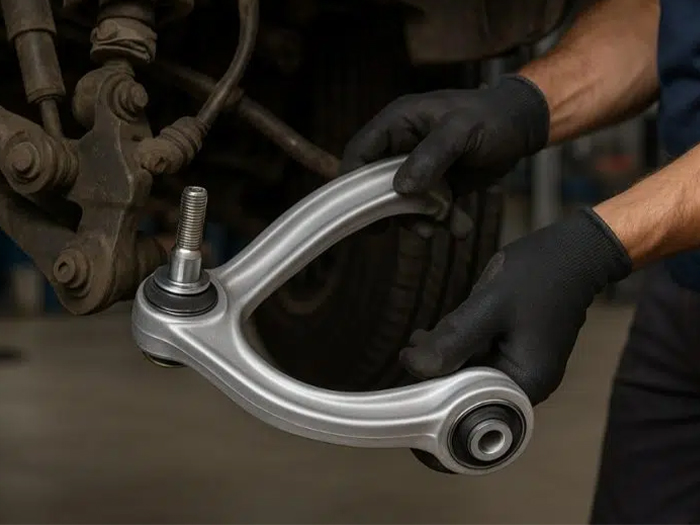
1. Why Control Arm Integrity Matters for B2B Sourcing
Automotive suspension components sit at the very heart of vehicle safety, structural stability, and driving comfort. Among these critical assemblies, the control arm—often called the A-arm or wishbone—serves as the primary pivot connecting the wheel hub to the vehicle frame. It guides wheel articulation, maintains precise wheel alignment angles, and absorbs severe dynamic loads generated during braking, cornering, and rough road transit.
For automotive spare parts wholesale businesses, regional distributors, and professional auto repair shop owners, sourcing control arms is far more than a simple catalog procurement exercise. When an aftermarket control arm fails prematurely due to a cracked structural body, degraded rubber bushing, or loose ball joint, the commercial ripple effects are immediate and severe. Distributors face costly warranty claims, logistics overheads, and damaged reputations. Mechanics suffer lost billable hours and client distrust.
In today’s hyper-competitive aftermarket ecosystem, sourcing decision-makers need actionable engineering criteria to evaluate suspension parts before placing bulk purchase orders. Choosing a high-caliber control arm supplier requires looking beyond superficial surface finishes and unit price tags. It demands a rigorous examination of metallurgy, precision welding, elastomeric compound chemistry, quality management systems, and factory manufacturing capabilities.
2. Anatomical Breakdown: The Three Pillars of a Control Arm
To evaluate what truly makes a control arm reliable, one must analyze its core architectural components. A control arm assembly operates as a cohesive mechanical ecosystem comprising three primary elements: the structural body, the inner pivoting bushings, and the outer ball joint.
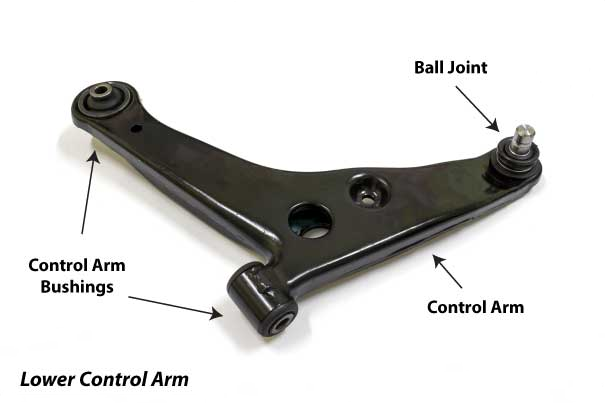
A. Structural Arm Body (Stamped Steel, Cast Iron, & Forged Aluminum)
The body provides the fundamental load-bearing strength. Depending on vehicle architecture and performance requirements, manufacturers utilize three dominant materials:
- Stamped Steel: Stamped high-strength steel offers exceptional tensile strength and cost-efficiency, making it popular for high-volume passenger vehicles. Dual-plate stamped designs welded together create a rigid hollow structure.
- Ductile Cast Iron (Nodular Iron): Used heavily in heavy-duty trucks, SUVs, and commercial vehicles where high compression strength and fatigue resistance are essential under heavy loads.
- Forged / Cast Aluminum Alloy: Unmatched weight reduction and exceptional heat dissipation. Lightweight aluminum control arms reduce un-sprung mass, dramatically improving vehicle handling and fuel economy.
B. Isolation Bushings (Natural Rubber vs. Polyurethane vs. Hydraulic)
Control arm bushings isolate the vehicle chassis from road noise, vibration, and harshness (NVH) while allowing smooth angular rotation. Premium bushings utilize high-grade natural rubber formulations blended with anti-aging chemical additives to prevent premature cracking, thermal hardening, and oil degradation under high-stress cycles.
C. Ball Joint Assembly
The ball joint serves as the crucial spherical hinge enabling multi-axis movement during steering and suspension flexing. A reliable ball joint features a heat-treated alloy steel ball stud, a mirror-burnished spherical ball finish, low-friction synthetic grease, and a durable chloroprene rubber dust boot sealed with heavy-duty retaining rings.
3. Key Engineering Factors Defining a Reliable Control Arm
1. Superior Material Selection & Metallurgy
Reliability starts at the raw material level. Inferior manufacturers often use recycled scrap metal or low-grade steel alloys that contain micro-impurities, leading to structural fatigue under stress. Premium control arm manufacturing utilizes certified structural steel (such as Q235B or Q345B) or aerospace-grade 6061-T6 aluminum. Chemical composition analysis via optical emission spectroscopy ensures consistent grain structure and mechanical performance across every production batch.
2. Advanced Robotic Welding & Structural Integrity
In stamped steel welded control arms, seam weld quality dictates structural integrity. Manual welding introduces human error, inconsistent bead penetration, and porosity. Industry-leading factories employ multi-axis robotic MAG welding systems with automated real-time seam tracking. Ultrasonic non-destructive testing (NDT) is regularly conducted to verify deep weld penetration without internal void formation.
3. Precision CNC Machining & Micro-Tolerances
A control arm must fit seamlessly into the vehicle chassis. If bushing housing bores or ball joint taper seats deviate by even a fraction of a millimeter, installation becomes difficult, causing improper wheel alignment, uneven tire wear, and vehicle pulling. Modern production lines utilize multi-axis CNC machining centers to maintain strict geometric tolerances within ±0.015mm, ensuring exact OE-matching dimensional accuracy.
4. High-Performance Rubber Bushings & Anti-Aging Formulations
The rubber-to-metal bond within bushings is a frequent failure point in low-cost aftermarket parts. High-grade control arms undergo specialized chemical phosphating and adhesive vulcanization processes to achieve high tear-off strength between the inner metal sleeve and the elastomeric body. Premium rubber compounds remain resilient across extreme temperatures ranging from -40°C up to +120°C.
5. Premium Ball Joint Construction & Dust Boot Sealing
Water ingress and grease leakage account for over 80% of aftermarket ball joint failures. Premium assemblies utilize high-grade synthetic lithium grease, heat-treated 40Cr steel ball studs, and heavy-duty dust boots that resist ozone, road salt, and abrasion. Double-lipped sealing rings secure the boot against environmental contaminants.
6. Surface Anti-Corrosion Treatment
Exposed to road salt, mud, and water splash, control arms are highly vulnerable to oxidation. Quality manufacturers apply multi-layer electrophoretic coating (E-coating) or advanced powder coating that withstands over 500 to 1,000 hours of continuous salt spray testing (ASTM B117 standards) without rusting.
4. Comparative Breakdown: OEM-Grade vs. Low-Cost Control Arms
To assist purchasing managers and wholesale buyers, the following table highlights the critical differences between premium, reliable control arms and low-cost aftermarket alternatives:
| Engineering Feature | Premium OEM-Grade Control Arm | Low-Cost Aftermarket Control Arm |
| Raw Materials | Certified structural steel / 6061-T6 aluminum alloy; verified grain density. | Uncertified recycled metal or low-grade steel with micro-impurities. |
| Manufacturing Process | Automated robotic welding & multi-axis CNC machining. | Manual welding with inconsistent bead penetration & wider tolerances. |
| Bushing Compound | High-grade natural rubber with thermal & anti-ozone additives. | Recycled rubber prone to premature cracking & sleeve detachment. |
| Ball Joint Design | Heat-treated 40Cr stud, mirror-burnished ball, neoprene boot. | Untreated carbon steel stud, rough finish, low-grade rubber boot. |
| Corrosion Protection | E-coating with 500-1000 hr salt spray resistance. | Basic paint prone to chipping, flaking, and rapid rust formation. |
5. Testing, Quality Assurance & B2B Sourcing Checklist
When vetting an automotive spare parts wholesale partner or evaluating control arm samples, professional buyers should demand proof of rigorous lab and physical testing. Reliable manufacturers subject their suspension parts to comprehensive validation protocols:
1. Dynamic Fatigue & Endurance Testing: Measures the fatigue life under millions of cyclic loads, replicating severe road conditions to ensure the arm body will not crack over extended service life.
2. Tensile & Yield Strength Testing: Verifies the ultimate tensile and compressive forces the control arm can withstand before plastic deformation or fracture occurs.
3. Bushing Push-out & Bonding Force Test: Evaluates the force required to separate the rubber from the metal sleeve, preventing sleeve slippage under severe braking.
4. Ball Joint Pull-Out & Push-Out Test: Measures the extraction and pull-out resistance of the ball stud from its housing under extreme tension.
5. Salt Spray Corrosion Chamber Testing: Accelerated environmental testing simulating harsh winter salt-treated roads to guarantee long-term surface protection.
Wholesale Sourcing Checklist:
Before finalizing a wholesale procurement contract with any China Auto Parts Supplier, verify their ISO/IATF 16949 certification status, inspect third-party material test reports, and request physical sample evaluation for CNC fitment verification. |
6. Ujoin Auto Parts as Your Reliable Control Arm Supplier
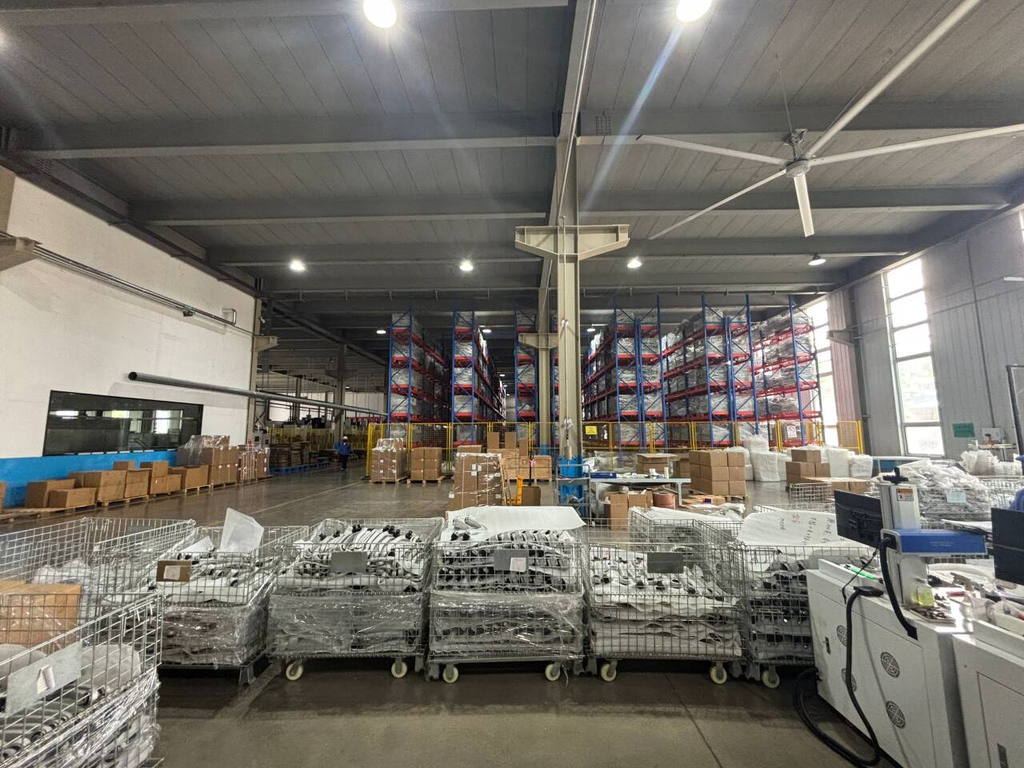
Navigating the global automotive aftermarket requires a trusted manufacturing partner who understands precision engineering, mass-production consistency, and B2B commercial expectations. Ujoin Auto Parts stands as a premier China Auto Parts Supplier and control arm supplier committed to empowering automotive spare parts wholesale distributors worldwide.
• Extensive Vehicle Coverage & OEM Compatibility
UJ Auto Parts maintains an expansive product catalog covering thousands of vehicle SKUs across American, European, Japanese, and Korean passenger cars, commercial vehicles, and light trucks. Whether supplying high-volume replacement parts or specialized chassis components, Ujoin delivers exact OEM-fit alignment.
• IATF 16949 Certified Manufacturing Rigor
Quality is baked into every stage of production at Ujoin. Operating under strict IATF 16949 quality management protocols, Ujoin combines automated robotic welding, high-precision multi-axis CNC machining, and automated optical inspection systems to guarantee zero-defect manufacturing consistency.
• Cost-Effective Wholesale Direct Supply
By leveraging state-of-the-art lean manufacturing technology and direct factory supply chains, Ujoin Auto Parts provides B2B clients with highly competitive factory-direct pricing without ever compromising on material quality or structural integrity. This enables distributors and repair facilities to maximize their profit margins while offering end-customers exceptional reliability.
• Global Logistics, Flexible MOQ, & Professional Support
From custom packaging and private labeling to flexible MOQ structures and fast global freight support, Ujoin acts as a seamless manufacturing arm for your business. Dedicated B2B sales engineers provide technical support, catalog matching, and responsive after-sales service.
7. FAQ
Q1: What are the most common signs of a failing control arm?
Common indicators include clunking, popping, or snapping noises when driving over bumps or turning, vehicle pulling or drifting to one side, steering wheel vibration at highway speeds, and uneven, rapid tire tread wear resulting from alignment drift.
Q2: How long should a quality aftermarket control arm last?
A high-quality control arm manufactured to OEM specifications should last between 80,000 to 100,000 miles (130,000 to 160,000 km) under normal driving conditions. Lifespan depends heavily on road quality, vehicle load, and environmental exposure to salt and moisture.
Q3: Should control arms be replaced in pairs?
Yes, automotive professionals strongly recommend replacing control arms in pairs (both left and right sides simultaneously). Since both sides experience similar wear and tear, replacing only one side can cause uneven suspension dampening, handling imbalances, and premature wear on adjacent components.
Q4: What certifications should B2B buyers look for in a control arm supplier?
Wholesale buyers should prioritize suppliers certified under ISO 9001 and IATF 16949 (the international quality standard for automotive manufacturing). These certifications confirm that the factory adheres to strict quality controls, traceable material sourcing, and standardized production workflows.
Q5: Why source control arms from a China Auto Parts Supplier like Ujoin Auto Parts?
Sourcing from an established manufacturer like Ujoin Auto Parts offers the optimal balance of advanced manufacturing technology, rigorous quality testing, competitive factory-direct pricing, and comprehensive vehicle application coverage, maximizing commercial profitability for distributors.
8. Conclusion
Selecting a reliable control arm comes down to uncompromised engineering: premium structural metallurgy, high-strength robotic welds, high-grade elastomeric bushings, precision CNC tolerances, and robust ball joint sealing. For automotive spare parts wholesale businesses, regional distributors, and repair centers, partnering with an experienced, quality-driven manufacturer is the single best strategy to eliminate warranty claims and build long-term market leadership.
As a dedicated China Auto Parts Supplier, Ujoin Auto Parts is committed to delivering superior suspension solutions that exceed global aftermarket standards. Upgrade your inventory with high-performance chassis components designed for ultimate safety and durability.